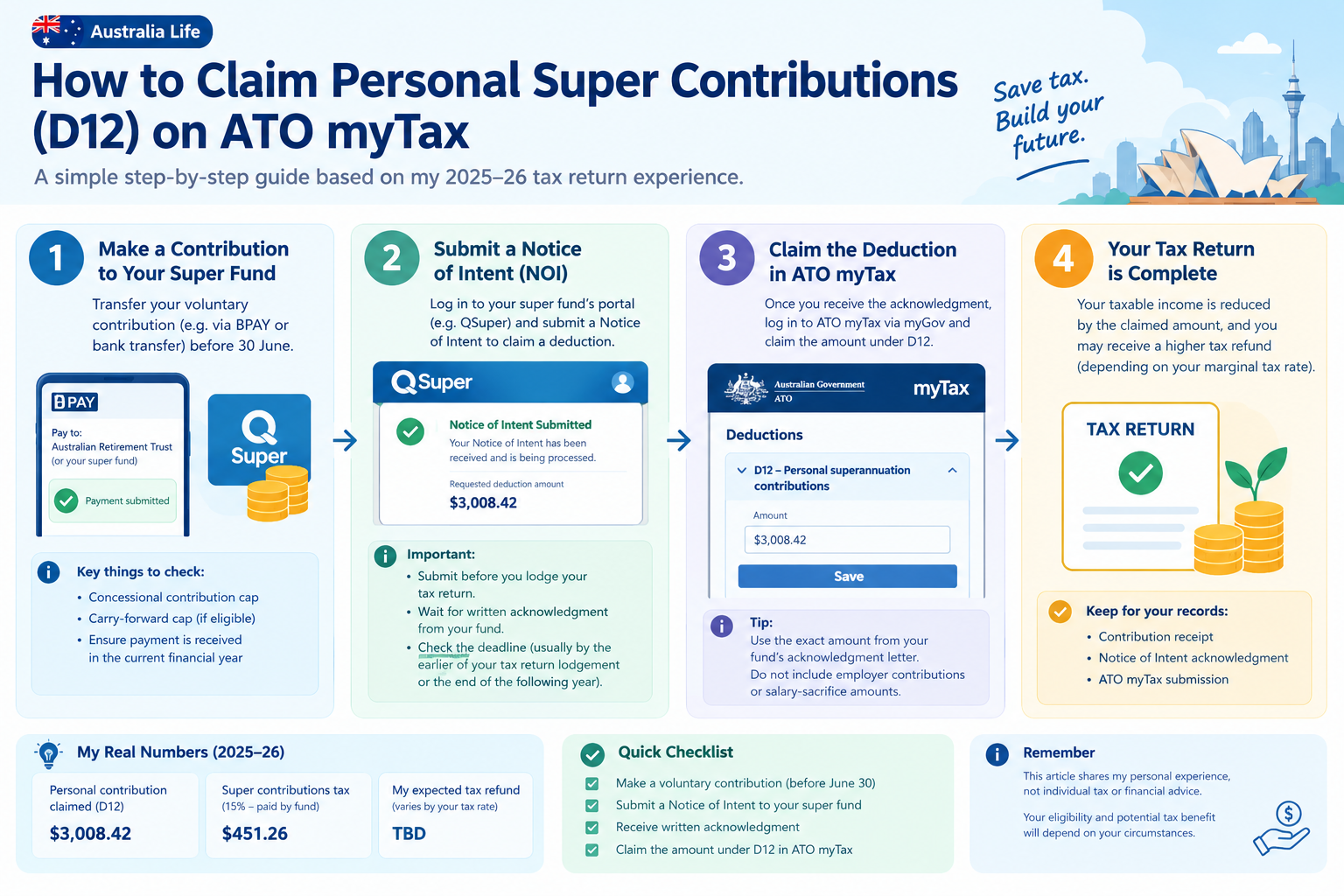
Lodging an Australian tax return through ATO myTax is an opportunity to claim deductions you are eligible for and potentially reduce your tax bill. One option available to eligible individuals is claiming a tax deduction for personal superannuation contributions.
I used this process in my 2025–26 tax return. After making a voluntary contribution to my super fund, QSuper, I submitted a Notice of Intent to claim a tax deduction for $3,008.42 and then claimed the acknowledged amount under D12 in ATO myTax.
In this guide, I’ll explain the process I followed, the documents involved and the important rules to understand before trying it yourself.
This article shares my personal experience, not individual tax or financial advice. Your eligibility and potential tax benefit will depend on your circumstances.
1. How Do Personal Super Contributions Reduce Tax?
In Australia, you can generally make personal contributions to your super fund from your bank account. If you meet the eligibility requirements, you may be able to claim a tax deduction for some or all of those contributions.
Once a valid deduction is claimed, the amount is treated as a concessional contribution and is generally taxed at 15% inside the super fund. Your deduction reduces your taxable income, which may reduce the income tax you pay.
The actual benefit depends on your marginal tax rate, Medicare levy and other circumstances. Additional tax may apply to some higher-income earners.
My real example
For my 2025–26 tax return, I claimed a personal super contribution deduction of $3,008.42.
My super fund confirmed that the contribution was subject to the standard 15% contributions tax:
| Item | Amount |
|---|---|
| Personal contribution deduction claimed | $3,008.42 |
| Super contributions tax at 15% | $451.26 |
| Amount claimed as a deduction in my tax return | $3,008.42 |
The $451.26 is the 15% tax calculated on the contribution amount. It is not the amount of my income tax refund.
The key point is that I claimed the eligible gross contribution amount, rather than deducting the fund’s 15% contributions tax from the amount entered in my tax return.
2. Step 1: Make a Personal Contribution to Your Super Fund
First, I made a voluntary contribution to my super fund. Depending on your fund’s available payment methods, you may be able to contribute using BPAY or another accepted payment method.
Before contributing, check the following:
- Contribution caps: Your concessional contributions cap includes relevant employer contributions, such as compulsory Super Guarantee contributions and salary-sacrifice contributions, as well as personal contributions for which you claim a deduction.
- Carry-forward rules: If you meet the eligibility conditions, you may be able to use unused concessional cap amounts from previous years.
- Payment timing: Make sure your contribution is received by the fund in the intended financial year. Check the fund’s processing times rather than relying solely on the date you initiate the payment.
For my situation, the amount I eventually claimed was $3,008.42. Your appropriate contribution amount will depend on your income, existing super contributions and available cap.
3. Step 2: Submit a Notice of Intent (NOI)
This is the most important part of the process.
Making a personal contribution does not automatically make it tax-deductible. You must submit a valid Notice of Intent to claim a deduction for personal super contributions to your super fund.
I completed this step through my super fund, QSuper.
The general process is:
- Log in to your super fund’s online portal and find the personal contribution deduction or Notice of Intent option. Alternatively, use the fund’s accepted form.
- Enter the relevant contribution details and the amount you intend to claim as a deduction.
- Submit the Notice of Intent to your super fund.
- Wait for written acknowledgment that the notice has been received and is valid before claiming the deduction in your tax return.
For my claim, the amount was $3,008.42.
Do not skip the acknowledgment step. The fund’s written acknowledgment is an important requirement for claiming the deduction.
You must also meet the applicable deadline. Generally, the notice must be given by the earlier of the day you lodge your tax return for that financial year or the end of the following financial year. Other validity conditions can apply, including if you have withdrawn or rolled over super, or started a super income stream.
4. Step 3: Claim the Deduction Under D12 in ATO myTax
After receiving the acknowledgment from my super fund, I proceeded with my tax return through ATO myTax, accessed via myGov.
The process was straightforward:
- Log in to myGov and open ATO myTax.
- Start or continue your individual tax return for the relevant financial year.
- Navigate to the deductions section.
- Find D12 – Personal superannuation contributions.
- Enter the amount for which your fund has acknowledged a valid Notice of Intent.
- Review the rest of your tax return before lodging it.
In my case, I entered $3,008.42 under D12.
Use the amount confirmed by your fund and ensure it matches the valid notice. Do not enter employer super contributions or salary-sacrifice contributions as personal contributions under D12.
Your tax refund or amount payable will be calculated based on your complete tax return. The deduction does not guarantee a particular refund amount.
5. My Personal Super Contribution Checklist
Here is a summary of the process I followed for my 2025–26 tax return.
| Step | What I did | My experience |
|---|---|---|
| 1. Contribution | Made a voluntary contribution to my super fund | Prepared the contribution for the relevant financial year |
| 2. Notice of Intent | Submitted the notice to QSuper | Requested a deduction of $3,008.42 |
| 3. Acknowledgment | Waited for confirmation from the fund | Received acknowledgment for my notice |
| 4. Tax return | Entered the deduction under D12 in myTax | Claimed $3,008.42 |
Keep your contribution records and the fund’s acknowledgment for your own records.
6. Important Things to Check Before Claiming
Although the steps are relatively straightforward, not everyone can claim every personal super contribution as a deduction.
Before proceeding, check:
- You made an eligible personal contribution to your super fund.
- Your total concessional contributions remain within the applicable cap, or you understand the rules that apply if you exceed it.
- You meet the eligibility requirements for claiming the deduction.
- Your Notice of Intent is valid and submitted within the required timeframe.
- Your fund has acknowledged the notice before you claim the deduction.
- You have considered whether claiming the deduction could affect other entitlements, including the super co-contribution, or whether additional tax such as Division 293 tax may apply.
For the official rules, refer to the Australian Taxation Office’s guidance on personal super contributions and its Notice of Intent form and instructions.
Conclusion
Claiming a deduction for personal super contributions under D12 is a useful option for eligible Australian taxpayers who want to build their retirement savings while potentially reducing their taxable income.
In my 2025–26 tax return, I submitted a Notice of Intent for $3,008.42 through QSuper, received the fund’s acknowledgment and claimed the amount under D12 in ATO myTax.
The most important lesson from my experience is simple: make the contribution, submit a valid Notice of Intent, receive the fund’s acknowledgment, and then claim the eligible amount in your tax return.
Take the time to check your contribution caps, eligibility and deadlines before proceeding. Done correctly, this process can be a useful part of your personal tax planning.
Leave a Reply