Many Australian homeowners install solar panels and a home battery hoping to eliminate their electricity bills completely. While solar and battery storage can significantly reduce grid usage, achieving a $0 bill every month is not always realistic.
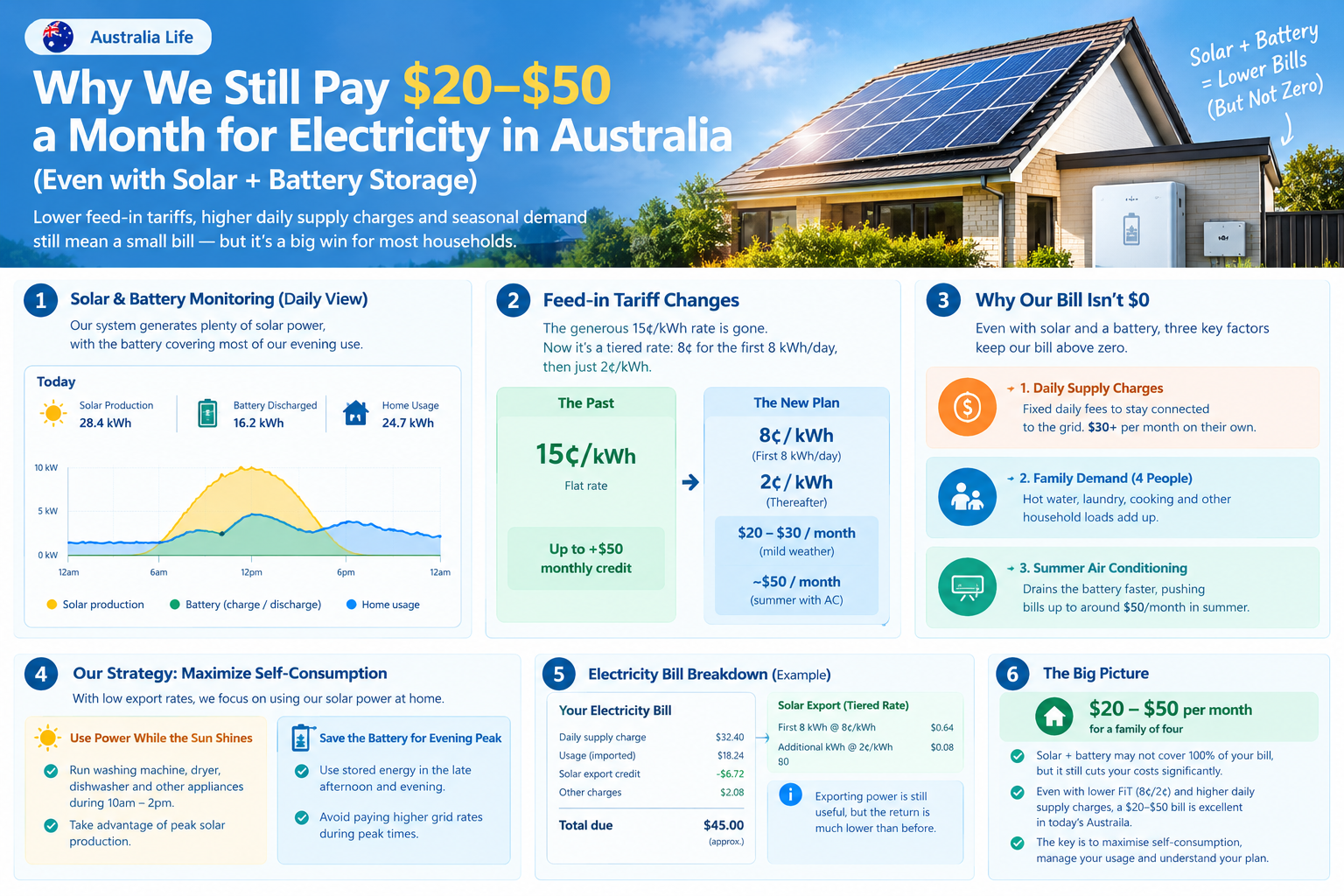
In our household of four, we still pay around $20–$30 per month during milder months, even with solar panels and battery storage. During summer, when we expect to use our ducted air conditioning more frequently, we estimate the bill could reach around $50 per month.
One major reason is the change in our electricity plan. We previously received a flat feed-in tariff of 15 cents per kilowatt-hour (kWh) for excess solar electricity exported to the grid. Under our renewed plan, the rate is now tiered: 8 cents per kWh for the first 8 kWh exported per day, then just 2 cents per kWh beyond that.
Here is why our bill is not zero, how the new rates affect us, and what we do to get more value from our solar system.
1. Feed-in Tariffs: From 15¢ to 8¢ and 2¢
A few years ago, exporting excess solar power could provide a useful financial return. When our system generated more electricity than we needed, we could receive credits that helped offset our electricity costs.
Under our previous plan, the feed-in tariff was a flat 15¢ per kWh. During sunny months, those credits could reach approximately $50 in a month.
Our renewed plan has different rates:
- First 8 kWh exported per day: 8¢ per kWh.
- Additional exports: 2¢ per kWh.
These rates apply to our current plan, rather than every electricity plan in Australia.
The difference is significant. If we export a large amount of excess electricity, much of it earns only 2¢ per kWh. That makes exporting surplus solar power less financially attractive than it used to be.
It also changes how we think about using our system. Instead of focusing mainly on exporting as much electricity as possible, we now try to use more of the electricity we generate at home.
2. Why Our Electricity Bill Is Still $20–$50 a Month
Even with solar panels and battery storage, three factors help explain why we still receive an electricity bill.
Daily supply charges
Our home remains connected to the electricity grid, so we pay a daily supply charge regardless of how much electricity we import.
For example, a supply charge of $1.04 per day adds up to approximately $31.60 over a 30-day month, before usage charges and solar credits are considered.
The actual amount depends on the retailer and electricity plan. Solar panels and batteries do not automatically remove this fixed charge.
Household electricity consumption
With four people in the household, electricity use comes from more than lighting and appliances. Hot water, laundry, cooking, refrigeration and other everyday activities all contribute to our demand.
Our battery helps cover much of our evening electricity use, but it cannot necessarily cover everything. If household demand exceeds the available stored energy, we may need to import electricity from the grid.
Summer air conditioning
Seasonal demand is another important factor.
During milder weather, our solar and battery system can cover much of our household consumption. In summer, however, running ducted air conditioning for extended periods can increase electricity use considerably.
If the battery runs low while the air conditioning is still operating, we may need to draw power from the grid. That is why we expect our bill to rise from around $20–$30 per month in milder months to approximately $50 during summer.
These figures reflect our household’s experience and expectations, not a guaranteed result for every home with solar and battery storage.
3. Our Strategy: Use More Solar Power at Home
With our export rate dropping to just 2¢ per kWh after the daily threshold, we focus more on self-consumption: using our own solar electricity instead of exporting it and buying electricity back later.
Run appliances during daylight hours
When practical, we schedule energy-intensive appliances such as the washing machine, dryer and dishwasher to run during the day, particularly when solar production is strong.
For our household, late morning to early afternoon is often a useful window. However, the best time depends on the weather, the direction of the solar panels and our system’s actual production.
Using solar electricity directly can reduce the amount we need to import from the grid later.
Keep battery capacity for evening use
Our battery helps cover household electricity demand after sunset, when solar production falls or stops.
We aim to make good use of the stored energy during the late afternoon and evening, when household activity often increases.
The best battery strategy depends on its capacity, the household’s consumption pattern and the electricity plan. Some systems also allow scheduled charging or other settings, so it is worth checking how your own system operates.
Monitor the system rather than guessing
Solar and battery monitoring apps help us understand when electricity is generated, stored, consumed and imported from the grid.
Reviewing these figures can reveal whether appliances are running when solar production is low, whether the battery is regularly depleted before morning, or whether substantial excess electricity is being exported for a low return.
Actual monitoring data is more useful than assuming that a solar system always covers the home’s needs.
4. How Our Old and New Electricity Plans Compare
| Energy metric | Previous plan | Renewed plan |
|---|---|---|
| Feed-in tariff | Flat 15¢/kWh | 8¢/kWh for the first 8 kWh/day, then 2¢/kWh |
| Solar export credits | Up to around $50/month in sunny months | Lower returns for exports above the daily threshold |
| Household bill | Could be offset by export credits | Around $20–$30/month in milder months |
| Summer expectation | Depends on usage and export credits | Around $50/month with heavier air conditioning use |
| Main strategy | Benefit from exporting surplus solar | Increase self-consumption and use battery storage effectively |
These figures describe our experience with our own electricity plan. Your supply charges, feed-in tariff, usage rates and final bill will depend on your retailer, location and contract.
5. Is Solar and Battery Storage Still Worth It?
For our household, keeping the monthly electricity bill around $20–$50 is a positive result. It means our solar panels and battery are covering a substantial portion of our electricity needs, even though we have not eliminated every charge.
However, a low electricity bill alone does not tell the whole financial story. Solar and battery systems have upfront installation costs, and the overall financial benefit depends on system size, household consumption, electricity rates, feed-in tariffs and how long the system is used.
Before changing electricity plans, it is worth comparing the daily supply charge, import rates, solar export rates and any time-of-use conditions. A plan with an attractive feed-in tariff may not necessarily be the cheapest overall option.
Conclusion
Solar panels and battery storage can dramatically reduce electricity costs, but they do not guarantee a zero-dollar bill. Lower feed-in tariffs, daily supply charges and seasonal electricity demand can all leave a household with something to pay.
In our case, the goal has shifted from earning credits by exporting excess electricity to making better use of the solar power we generate.
For a family of four in Australia, paying around $20–$30 per month in milder weather and an estimated $50 during summer is a result we are happy with. The important thing is to understand your own electricity plan, monitor your system and use your solar power as efficiently as practical.
Leave a Reply