Introduction
Staying connected on an Australian family camping trip can be surprisingly hard. Even at popular sites like Woody Head Campground in NSW, we had almost no mobile signal at our tent site. Getting a single bar meant walking down to the beach.
Australia is vast, and mobile blackspots are common once you leave the major highways. That’s why satellite internet has become a must-have for many 4WD and caravan campers.
The Starlink Mini is SpaceX’s compact, portable satellite dish. But once you add up the hardware and the monthly plan, is it actually worth it for Australian family camping?
In this post, I cover current Australian pricing, power options, plan choices and practical campsite setup tips, with prices checked as of November 2026.
1. Hardware Price & Mounting: Roof Mount vs Ground Setup
The Starlink Mini launched in Australia at $599 AUD. Prices have dropped a lot since then.
- Hardware price: Major retailers like JB Hi-Fi, Officeworks, Bunnings and Harvey Norman now sell the Mini kit for about $287–$289 AUD. Starlink also runs occasional promotions in selected areas.
- Roof mounts ($70–$250): Roof brackets for 4WD roof racks or caravans vary widely in price.
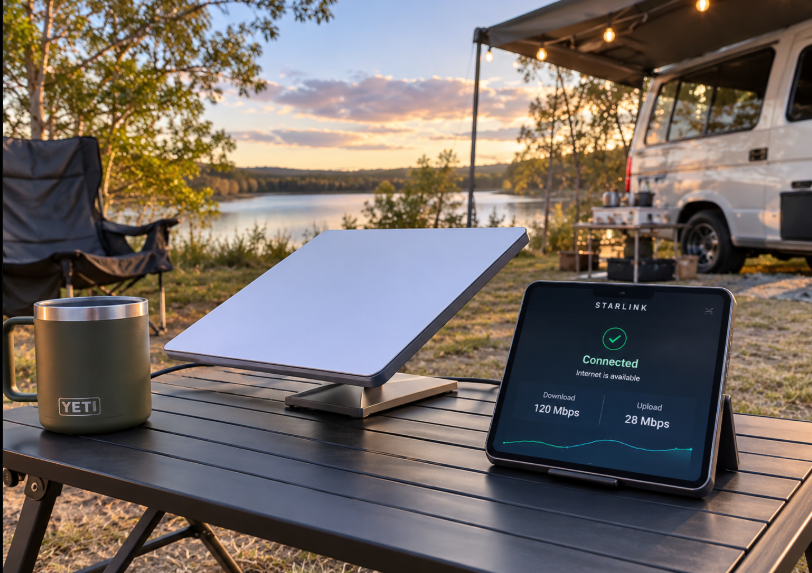
My setup tip: Unless you need internet on the move, you don’t need a roof mount. When you arrive at camp, unpack the dish and place it on the ground or on a portable stand. This lets you move it away from tree canopy for a clear view of the sky. Use the “Check for Obstructions” tool in the Starlink app to find the best spot.
2. Power: 12V DC vs 240V Power Station
Before you head off-grid, plan how you’ll power the dish.
- 12V DC (most efficient): The Starlink Mini runs natively on 12–48V DC and draws around 25–40W on average. Powering it from your 4WD’s 12V socket or dual-battery system with a suitable DC cable, or with a USB-C PD charger rated 100W or higher, avoids conversion losses.
- 240V via a power station: You can plug the included 240V adapter into the AC outlet of a portable power station such as an EcoFlow or Jackery. The catch is that the inverter typically wastes around 10–20% of the energy, so your battery runs down faster.
Check before you go: Some vehicle 12V sockets switch off with the ignition. Confirm that yours stays live, or run power from your auxiliary battery. For our full vehicle setup, see our Prado 150 camping setup.
3. Flexible Plans: Roam vs $15 Standby Mode
Starlink plans are month-to-month with no lock-in contract, which suits campers well.
- Roam 100GB – $85/month: Good for weekend family trips, light streaming and staying in touch in blackspots. Once you use the 100GB, speed drops to about 0.5Mbps for the rest of the billing month.
- Roam Unlimited – $210/month: For remote workers or families on extended laps of Australia.
- Standby Mode – $15/month: If you’re not camping for a few months, switch to Standby instead of cancelling. You keep your account and still get unlimited low-speed data of up to 0.5Mbps. That’s enough for messaging, Wi-Fi calling, email and maps, but not video. Standby only works while stationary. When your next trip comes up, switch back to a Roam plan in the app.

4. Cost & Feature Breakdown
| Item | Details |
|---|---|
| Hardware | ~$287–$289 at major retailers (launched at $599) |
| Mounting | $70–$250 for a roof mount, or $0 with a ground setup |
| Active plans | Roam 100GB ($85/mo) or Roam Unlimited ($210/mo) |
| Off-season | Standby Mode $15/mo (0.5Mbps unlimited, stationary only) |
| Power | 12–48V DC or USB-C PD 100W+ (efficient) vs 240V inverter (~10–20% loss) |
| Real-world use | Solves blackspots at sites like Woody Head Campground |
Prices as of November 2026. Check Starlink and retailers for current pricing.
FAQ
Can I use Starlink Mini while driving?
Using it on the move requires a proper vehicle mount. For most family campers, a ground setup at camp is all you need.
How long will Starlink Mini run on a power station?
At an average of 25–40W, a 500Wh power station gives you roughly 10–15 hours over 12V DC, and less through the 240V inverter.
Does Standby Mode still work at camp?
Yes, but only for low-speed use (up to 0.5Mbps) while stationary. It’s enough for messages and maps, not for streaming.
Verdict: Is It Worth It for Australian Campers?
In a country this big, zero-reception campgrounds like Woody Head are almost guaranteed.
The numbers stack up for families who camp regularly:
- the dish costs under $300
- a ground setup means no mounting costs
- you can drop to $15/month Standby between trips
For that, you get reliable connectivity at camp. It adds convenience, lets you check weather and road updates, and keeps the family in touch. Just remember that it’s no substitute for a PLB.
Planning your next trip? See our family camping checklist and how much family camping really costs in Australia.
Leave a Reply